

Turniansky hrad
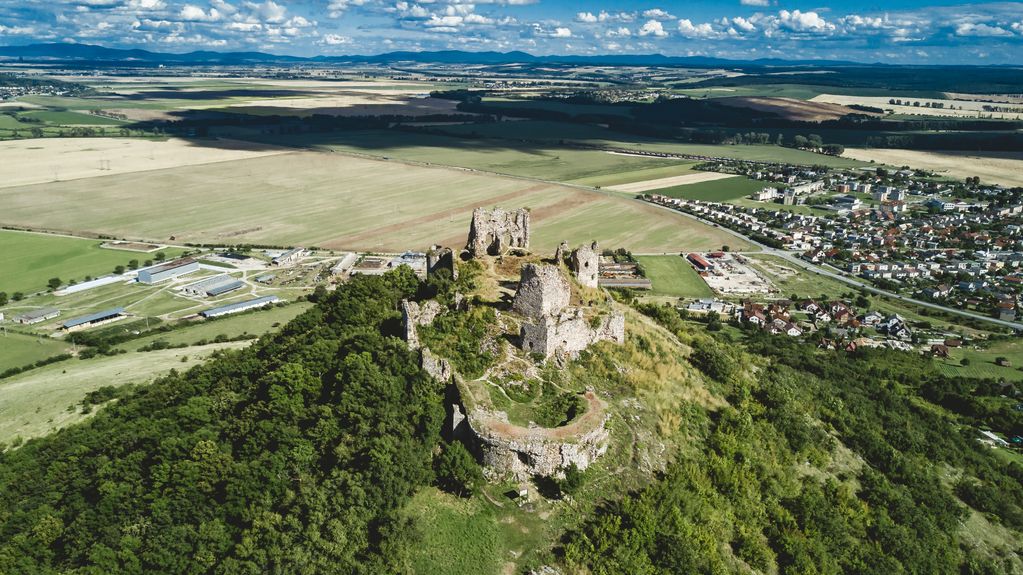
Turniansky Castle was founded at the latest at the turn of the 13th and 14th centuries and is one of the important historical landmarks of southeastern Slovakia. Its ruins are located above the village of Turňa nad Bodvou, on a prominent karst hill at an elevation of approximately 375 m above sea level, within the Slovak Karst National Park. Due to its strategic position, the castle once served as an important guard post controlling trade and military routes in the region.
From the castle area, extensive views open over the surrounding landscape. Visible are the village of Turňa nad Bodvou, the beautiful Hájska Valley, the village of HáJ, the Jasov Plateau, parts of the Zádiel Plateau, as well as the Košice Basin and the Turna Basin. This location makes the castle an attractive destination for tourists, photographers, and history enthusiasts who can enjoy the combination of nature and medieval architecture.
Remnants of the original structures are still preserved on site, documenting the former grandeur of the castle. Visible are parts of the defensive walls, bastions, palace structures, and the castle tower. Although the castle is no longer intact, its ruins still appear majestic and remind visitors of its historical importance.
The castle was destroyed during the 17th-century anti-Habsburg uprisings, when it was demolished in 1685 on the orders of General Schultz during the conflicts led by Thököly. Since then, it has remained in ruins that have gradually survived to the present day.
There are two main hiking routes leading to Turniansky Castle. The first starts in the village of HáJ and follows the yellow hiking trail, while the second starts in Turňa nad Bodvou and partly follows the blue trail. Both routes offer a pleasant ascent with gradually opening views of the surrounding karst landscape.
Today, Turniansky Castle is freely accessible to the public, and its ongoing restoration is carried out by the civic association Castrum Thorna, which is dedicated to preserving this important cultural monument. The castle thus continues to connect history, nature, and volunteer efforts to preserve the cultural heritage of the Slovak Karst.