

Regions
The Spiš Region and Slovak Paradise
Spiš is a region of Slovakia with all the ingredients of a popular travel destination. It lies between four national parks: the Tatra National Park to the north-west, Pieniny National Park to the north, Slovak Paradise National Park to the south-east and Low Tatras National Park to the south-west.
Whichever direction you choose, Spiš will not let you leave easily. Its basins are captivating, as is its exceptionally rich treasury of artistic and historical monuments, particularly Gothic and Renaissance architecture, sculpture, murals and panel paintings. The region also boasts abundant travertine formations. It is home to Spiš Castle, Europe’s largest castle by area. The late Gothic limewood altar in the Church of St James in Levoča is the tallest of its kind in the world. The tower of the Church of the Assumption of the Virgin Mary, Slovakia’s tallest church tower, dominates the skyline of Spišská Nová Ves from every direction. The town is rightly known as the Gateway to Slovak Paradise. Even a short walk in this national park brings the unforgettable views from Tomášovský výhľad. The scenery is equally absorbing on a walk through the Hornád Gorge or the park’s other gorges and ravines. Slovakia’s charming smallest zoo is another popular attraction.


Best-known sights
We begin our journey through Spiš at a Romanesque and Gothic jewel, UNESCO-listed Spiš Castle. This was the birthplace of John Zápolya, the last Hungarian king to reign before the accession of the Habsburg dynasty. The castle is one of Europe’s most extensive castle complexes and the largest castle in Slovakia.
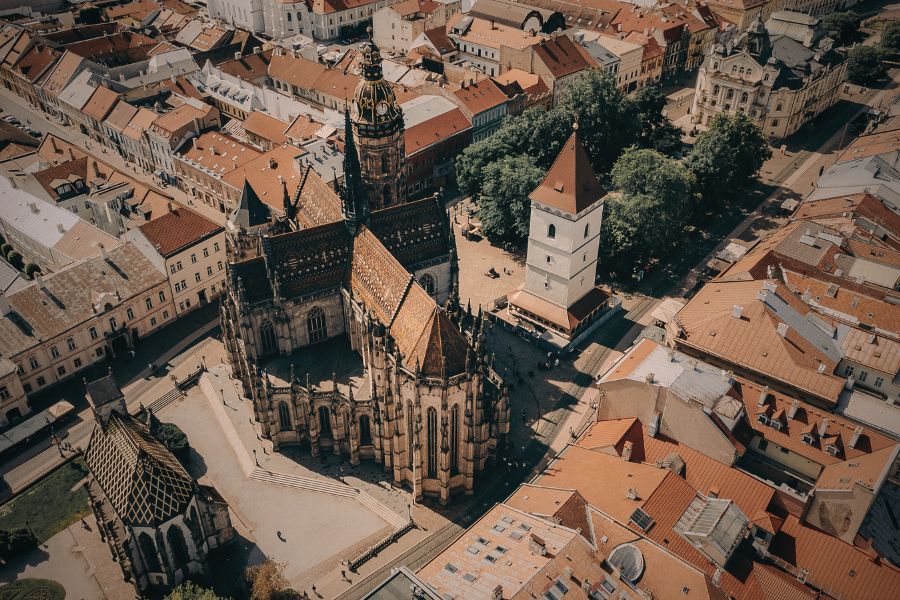
This journey through the Middle Ages should certainly continue with visits to Spišská Kapitula, St Martin’s Cathedral and the site known as Spiš Jerusalem. An excellent detour leads to Žehra and its early Gothic Church of the Holy Spirit with valuable frescoes. Nearby natural attractions include Dreveník, a rocky plateau approximately two kilometres long, with characteristic travertine towers. It is Slovakia’s largest travertine formation. Townhouses, a Gothic town hall and an originally Romanesque church tell the story of the nearby medieval town of Spišské Vlachy.
Heading west, we reach Markušovce, where a magnificent Renaissance manor house, later remodelled in Rococo style, catches the eye. Its grounds include a French-style park with the Dardanely summer pavilion. About five kilometres from Markušovce stands the well-known Markušovce Rock Mushroom, a geological formation created where two different rock layers meet. It is around eight metres tall. Wind, rain and frost have a stronger effect on its faster-weathering “stem”, while the “cap” is more resistant.
The Hornád then leads us to Spišská Nová Ves, whose skyline is dominated from afar by Slovakia’s tallest church tower, at 87 metres, belonging to the mid-14th-century parish Church of the Assumption of the Virgin Mary. Other surviving historic buildings include a late-18th-century Neoclassical Lutheran church. Equally impressive is Slovakia’s largest spindle-shaped square, lined with merchants’ and craftsmen’s houses and a Neoclassical town hall, together conveying the town’s former importance.
The ancient town of Levoča is a true cultural and historical treasure among Slovakia’s towns. Its 14th-century parish Church of St James has an exceptionally valuable interior filled with medieval sacred art. The late Gothic limewood high altar of St James stands 18.6 metres tall, making it the tallest of its kind in the world. A stroll through the town immediately reveals the Renaissance Thurzo House and the town hall, whose origins date back to the 15th century.
An essential stop on any journey through Spiš is the captivating landscape of Slovak Paradise, with its cliffs and ravines, including walks through the Hornád Gorge and Suchá Belá Gorge.
Spiš is enchanting in winter too. Around Mlynky, Dedinky and Hnilčík, families with children, beginners and experienced visitors can enjoy downhill and cross-country skiing. The resorts include Biele Vody, Dedinky, Gugeľ and Mraznica, whose main ski slope is 1,650 metres long with a vertical drop of 282 metres.
Spiš offers several options for cross-country skiing. Around the Dobšiná Ice Cave, there are four marked, machine-groomed circuits ranging from 2.4 to 4.5 kilometres. Mlynky – Biele Vody has several groomed trails, including a circuit of approximately ten kilometres around Kráľova hora.
Further trails can be found at Grajnár near Spišská Nová Ves, at the airfield in Spišská Nová Ves, in the Schulerloch area and in Novoveská Huta, where the longest circuit measures 20.5 kilometres. Grooming depends on current snow conditions.
The Gothic Route connects Spiš’s most important Gothic monuments and also passes through the Gemer region.

Lesser-known places
On the outskirts of Spišská Nová Ves, Slovakia’s smallest and youngest zoo completes the local landscape. Its many trees and shrubs provide welcome shade for both animals and visitors. Spiš became home to much of M. R. Štefánik’s family. Spišská Nová Ves is said to have the finest monument dedicated to him, as well as the house where his mother Albertína lived with his younger brother Ladislav and later died. Just a few metres from their house, in the park below the tallest church tower, stands the Monument to the Electrification of the Town (1894). Spišská Nová Ves introduced electricity before Bratislava and other European capitals.
The nearby village of Smižany, Slovakia’s largest, offers an exhibition in the birthplace of Captain Ján Nálepka, a well-known Second World War fighter, and a valuable early Gothic church dating from the mid-13th century, although it has been rebuilt many times.
Smižany is only a short distance from Slovak Paradise, a place for truly refreshing walks in nature. The Kyseľ via ferrata and the globally unique Kopanické lúky meadows offer unforgettable experiences. The park’s southern part is popular for the Palcmanská Maša reservoir beneath the southern cliffs of Geravy and for the nearby accommodation, sports and recreational facilities.
In the summer heat, we recommend the natural swimming pool in the Levočská dolina recreation area near Levoča. The Lutheran church stands on the southern side of Levoča’s square. Inside are three galleries housing the organ, an archive and a valuable library.
One of Slovakia’s last historic covered wooden bridges is in Kluknava. Its quality is demonstrated by the fact that its first major overhaul was not needed until a hundred years later. In the centre of Kluknava stands the bell tower of St Florian, dating from 1795.
From the great medieval Spiš Castle, continue to the little church in Chrasť nad Hornádom, built on the unique sandstone outcrop known as Farská skala. It is considered one of Slovakia’s oldest religious buildings. Do not miss Spišský Hrušov and its Renaissance-Baroque manor house either. The most important monument in Bijacovce is the Csáky manor house, dating from the 18th century and representing late Baroque, or Rococo-Neoclassical, residential architecture.
To visit another major mining village, head to Rudňany. Mining provided a livelihood here as early as the 14th century: silver and copper were extracted, followed later by iron and mercury. The mountain mining village of Poráč and the beautiful Poráčská dolina valley are now a tourist centre with numerous attractions and ski lifts. The Hnilec Cycle Route is also appealing in summer. Gelnica offers an open-air mining museum, the Pochwerk ore-stamping mill, the Jozef drainage adit, fresh-air walking trails and a mining museum.

Gastronomy
Before mentioning the legendary Spiš sausages or Spiš pirohy, let us serve a soup: kminova polifka, a caraway soup, or the delicious bryndzova polifka made with bryndza sheep’s cheese. Just as good-quality bryndza guaranteed the soup’s flavour, the secret of fine Spiš sausages lay in quality meat sourced exclusively from high-mountain pastures, paprika and seasonings that gave them their distinctive taste. The type of wood used for smoking mattered too. The sausages were always eaten by hand, and a snap when bitten was a sign of quality. But Spiš is not only about sausages: typical dishes include many variations on potatoes, filled pirohy, and halušky dumplings with excellent, wholesome bryndza carrying hints of the flowers and herbs of Spiš meadows. Other specialities include nalešniky, similar to potato pancakes, and the potato cake gruľovnik. The people of Spiš have always valued vitamin-rich sauerkraut. They have also long believed, and still say, that Spiš borovička, a juniper spirit, is the best traditional remedy for “burning out the worm”.

Typical regional products
It is often said that surroundings and natural scenery influence people and their creative work. Spiš was historically a wealthy region and has preserved this richness in visible, tangible forms, including varied local foods and traditional crafts. Visitors like to take home herbal gifts. Local people used these to warm themselves during winters that were once truly harsh. The cold also encouraged the development of furriery. The hides and furs of sheep and lambs, as well as wild foxes, wolves and bears, were important materials for making not only fur coats, but also fur waistcoats, traditional jackets, hats and gloves. Such craft products can remind you of this picturesque region after you return home.
Before leaving Spiš, pack some traditional fresh sheep’s cheese or Spiš bryndza for the journey.